-
2025
Enhancing Account Information Anonymity in Blockchain-Based IoT Access Control Using Zero-Knowledge Proofs Yuxiao Wu, Yutaka Matsubara, Shoji Kasahara
Electronics, Vol.14, Issue 14
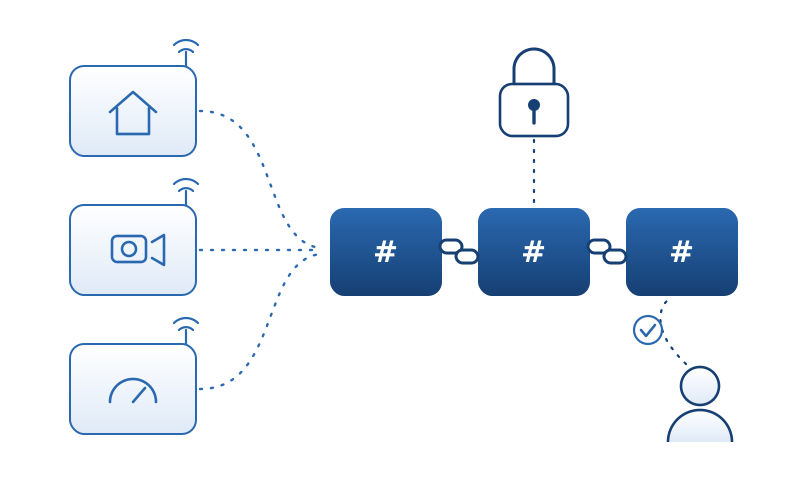
This paper uses zero-knowledge proofs to hide account information in blockchain-based access control for IoT devices, improving user privacy. Users can prove they have the right to access a device without revealing which account they are, so records on the public blockchain leak less personal information. This addresses the tension between blockchain transparency and privacy.
Link
-
2025
SSI-Enabled Authentication and Enhanced Metadata Search in Blockchain-based Decentralized IoT Data Platforms Luyonghe Li, Yuichiro Yasue, Yutaka Matsubara
IEEE 1st International Workshop on Blockchain for Decentralized Trust and Digital Identity (B4TI) at BCCA 2025, Croatia, Oct 2025
This paper adds self-sovereign identity (SSI) based authentication and better metadata search to blockchain-based decentralized IoT data platforms. With SSI, users control their own identity credentials instead of depending on a central provider, which matches the decentralized nature of the platform. Improved metadata search also makes shared IoT data easier to find and use.
-
2025
PPDS: A Practical and Privacy-Preserving Data Sharing Model for Blockchain-Based IoT e-Health Systems Using ECC, Zero-Knowledge Proof, and Access Control Yuxiao Wu, Kenta Kawai, Yutaka Matsubara
IEEE International Conference on Blockchain Computing and Applications (BCCA 2025), Croatia, Oct 2025
This paper proposes PPDS, a data sharing model for blockchain-based IoT healthcare systems that protects privacy using elliptic curve cryptography, zero-knowledge proofs, and access control. Health data is sensitive, so the model lets patients share records with the right parties while keeping identities and contents protected. The cryptographic building blocks are combined with practicality on IoT devices in mind.
-
2025
Flexible Edge Processing in Blockchain-based Secure IoT Data Distribution Framework Kenta Kawai, Yuxiao Wu, Yutaka Matsubara, Hiroaki Takada
BRAIN 2025 at PerCom 2025, Washington D.C., Mar 2025
This paper adds flexible edge processing to a blockchain-based framework for secure IoT data distribution, so data can be processed near its source. Processing data near where it is generated reduces network traffic and avoids sending raw personal data to distant servers. The blockchain still guarantees trust in the exchanged results.
-
2023
Supply-Demand Matching System for Circulating IoT Device Information Kenta Kawai, Yutaka Matsubara, Hiroaki Takada
DICOMO 2023, pp.45-56
Link
-
2022
Software Update Framework for IoT Devices Using Blockchain Ryota Nakanishi, Yutaka Matsubara, Hiroaki Takada
DICOMO 2022
Excellent Paper Award.
Link
-
2022
Excellent Paper Award for Software Update Framework for IoT Devices Using Blockchain Ryota Nakanishi, Yutaka Matsubara, Hiroaki Takada
DICOMO 2022
-
2020
Tsunagaru! Kiso Gijutsu IoT Nyumon (Chapter 2: Security) Harumi Watanabe, Makoto Imamura, Kenji Hisazumi (eds.)
Corona Publishing
An introductory textbook chapter on security for IoT systems, explaining basic threats and countermeasures for connected devices. It walks through how attackers can reach devices over the network and what basic defenses such as encryption and authentication do. The chapter is written for students taking their first steps into IoT.
Yutaka Matsubara authored Chapter 2.
-
2020
Secure Remote Software Update for Mindstorms EV3 Daichi Ito, Yutaka Matsubara, Hiroaki Takada
19th Complex Systems Micro Symposium, Sapporo
-
2020
Performance Evaluation of QUIC for Lightweight Secure Communication on IoT Devices Taiga Komatsu, Yutaka Matsubara, Hiroaki Takada
SCIS 2020, Kochi
-
2018
Secure Update Framework for IoT Devices Using Blockchain Technology Keigo Nagara, Yutaka Matsubara, Hiroaki Takada
ESS 2018 Proceedings, Gero, pp.36-39
Link
-
2018
Performance Evaluation of TLS 1.3 for IoT Devices Taiga Komatsu, Yutaka Matsubara, Hiroaki Takada
Computer Security Symposium 2018, Nagano, pp.569-576
-
2018
Secure Update Framework for IoT Devices Using Blockchain Technology Keigo Nagara, Yutaka Matsubara, Hiroaki Takada
SWEST20, Gero
-
2017
Automotive Security and IoT Yutaka Matsubara
Kinou Zairyo, Jun. 2017 serial article
A review article introducing the current state of automotive security in the context of the IoT era. It describes how connecting cars to networks and smartphones creates new attack paths, and outlines the countermeasures the industry is adopting. The article is written to be accessible to readers outside the software field.
-
2017
Portable DoS Test Tool for Embedded Systems Keigo Nagara, Katsunori Aoki, Yutaka Matsubara, Hiroaki Takada
ESS 2017 WiP, Gero
Link
-
2017
Attack Performance Evaluation of Mirai Malware on Embedded Systems Keigo Nagara, Yutaka Matsubara, Katsunori Aoki, Hiroaki Takada
IPSJ Research Report 2017-EMB-44 No.41, Okinawa, pp.1-6
Link
-
2017
Open-source Software-based Portable DoS Test Tool for IoT Devices Keigo Nagara, Katsunori Aoki, Yutaka Matsubara, Hiroaki Takada
Workshop on Internet of Things Security and Privacy with ACM CCS, Dallas